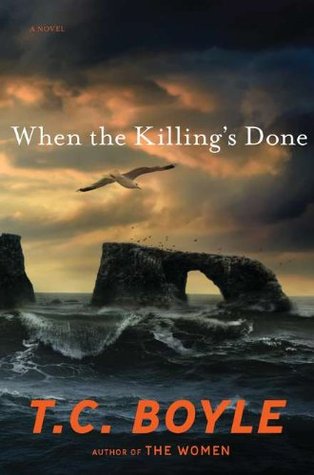
When the Killing’s Done

Knowing that Jay is a fan of novelist T. C. Boyle, on Friday one of his Daily Beast colleagues (who works in the books section) gave him an extra copy of Boyle’s latest novel.

When the Killing’s Done is officially is out tomorrow, and Boyle will be on The Takeaway to talk about some of the environmental questions it raises.  Over the weekend, I decided to give the book a read ahead of Boyle’s interview. I borrowed Jay’s copy and blogged about the book for The Takeaway:

Boyle gets around the difficulty of dramatizing environmental issues by dramatizing the environmentalists themselves. To drive home the tension between their positions, he draws out the similarities between Alma and her nemesis David. Alma and her biologist boyfriend Tim Sickafoose are vegetarians, and so are David and his girlfriend Anise Reed. They all live in the Santa Barbara area, they all drive white Priuses, and they all grapple with the quandaries of consumption while listening to the same hippie folksinger—and the similarities don’t end there. Like Alma, David’s girlfriend Anise has matrilineal ties to the islands: Her mother worked as a cook on an island sheep ranch in the 1970s.

Though their philosophies on what’s best for the natural world around them clash perfectly, Boyle makes it clear that both the Alma/Tim and David/Anise camps are equally motivated by a mix of childhood sympathies, inclinations of personality, and adult life politics. Our approach to moral questions about the environment, Boyle seems to suggest, is as complicated as the environment itself.

The full post is at The Takeaway’s blog.

One small thing I left out: I was more than a little bit annoyed at Boyle for making one of his character’s conversion to meatlessness come at the hands of a proselytizing Hindu.

Alma won’t touch the bacon– she hasn’t eaten meat since her conversion to vegetarianism in the seventh grade under the influence of her best friend, a girl from India whose parents were both doctors and who persisted in wearing a red caste mark on her forehead through the end of junior high …

Of course this is the only mention that this nameless character and her persistent “caste mark” get.  And of course, my annoyance comes from personal recognition of this particular bundle of stereotypes.  I stopped eating meat at age 10; my mom applied a small dab of kumkuma on my forehead every morning before school, after we said our prayers; my father is a physician.  But preach vegetarianism?  That kind of “girl from India” would know better.  So should Boyle.
The Scale of Maps

It is said, my friends, that a number located between seven and eight was lost with the writings of Diophantus, the algebraist.  Of course this is a legend, but I do not have to remind you of the theory that there can be no sign without a referent. It is tempting indeed.  Imagine, my friends: another number, an hour every day outside the flow of time, a month unaccounted for every year between July and August.

Belén Gopegui

I don’t know about you, but I wouldn’t mind if some secret hours, days, and months were quietly slipped into my life.  So much to do, so little time!

Among the things filling my recent accounted for hours: A review of The Scale of Maps by Belén Gopegui I wrote for the latest issue of Words Without Borders.  Enjoy!

Revolution in Egypt

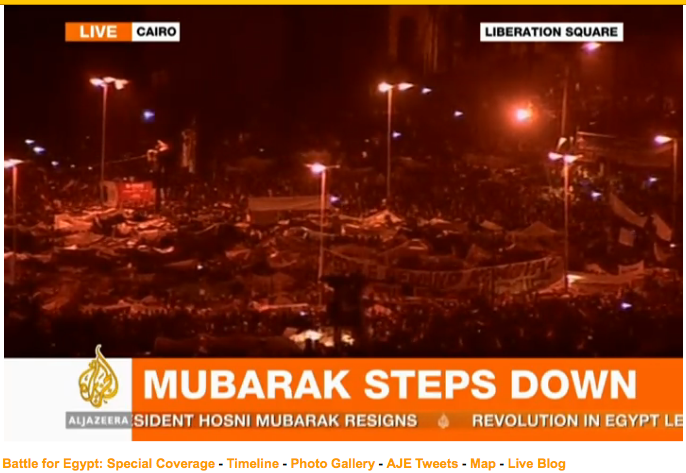
It took eighteen days (or was it thirty years?) but finally the man who once said “I have a PhD in stubbornness” has stepped down.

Undoubtedly, Egypt’s struggles are far from over — there are still too many unknowns at this stage — but for those of us watching from the other side of the world, what an exhilarating ride it’s been.

There’s also still no single answer to the question I posed last week — why now? — and President Hosni Mubarak’s resignation only raises more questions.  What will the military takeover mean for the country? Can the army make good on its promise to ensure fair and peaceful elections? Will the crowd that’s organized so bravely on the streets be able to find solid political footing in the halls of parliament? What will become of mid-level government officials who supported the old regime? What will become of Mubarak himself? Who will step up to fill the vacuum of democratic leadership? How will the United States reposition itself towards the new Egypt? How will Egypt’s economy regain its footing after three weeks of this $300-million-dollar-a-day disruption? What will this upheaval mean for the rest of the Mideast?

So far, Egypt’s revolution has been the most-covered international news story in 4 years — and it looks like the story is just getting started.

Winter and Their Discontent

Another winter storm, another revolution.  With more terrible weather expected overnight, I’ve packed up for yet another stay in a hotel across the street from my office — keeping tabs on Al Jazeera’s ongoing Egypt coverage all the while.  If today’s developments are any indicator, this week’s looking to be another very busy one at work. News from the Middle East has been nothing short of riveting, and I’ve been proud to be part of The Takeaway’s standout coverage of protests in the Middle East (including the brand new podcast launched today).

I’m still gathering my thoughts — and, like everyone else watching developments in Algeria, Yemen, Tunisia, Jordan, and Egypt from afar, “monitoring a very fluid situation,” to say the least — so for now, I’ll leave this post with just one question that’s been on my mind. It stems, in part, from an anecdote relayed by Wendell Steavenson, blogging for The New Yorker from Cairo:

A girl who had collapsed with stomach pains was brought in, carried in the arms of an Army captain. Her parents had taken their four children to the square in the morning and the family had been there for six or seven hours. Her father, Amr Helmy, a former Army officer, told me that he believed it was important that they see the demonstration. “They need to start getting used to them!” he joked, “so they learn that they don’t have to be afraid. Our generation wasted our life in nonsense.”

A courageous sentiment.  But why now?  That’s what I’ve been wondering.  It’s also the question that was posed on The Takeaway this morning by Shibley Telhami, Anwar Sedat Chair for Peace and Development at the University of Maryland:

For me as a political scientist, I’ve always said (and I’ve repeated it over and over again), the puzzle to me has never been, ‘are there reasons to revolt?’  The puzzle has always been, ‘why haven’t people revolted already?’

I’ll be mulling this over as events in Egypt unfold — and maybe when the storm passes, the answer will be more apparent.