Recent reviews and interviews: Fiction by Marlon James; nonfiction by Jill Lepore, Catherine Carr, Sarah O’Connor, Charlotte Proudman, Rebecca Solnit, and Siri Husvedt; plus, “Severed Minds,” an Audible Original

It’s been a busy and productive summer and autumn! Since June, I’ve been working with The Economist’s excellent podcast team (if you haven’t heard this three-part series on Tommy Robinson— which I didn’t work on but strongly recommend– don’t miss it, it’s very good).

You can hear a bit of what of what I’ve been up to with the Checks & Balance gang in the run up to the midterms here. A few of my favorites include this audio road-trip across Ohio (featuring the voices of locals discussing AI data centers at gas stations, on porches, and in coffee shops and craft stores); plus dispatches from a mega-church pastor in Kansas, a fisheries debate in Alaska, the sweltering Arizona border, and the campaign trail in Michigan.

A real delight of audio is how much terrain– literally! miles and miles– it can cover in minutes. It’s been a good run.

I’ve also carried on with other freelance work. For Intelligence Squared I interviewed: 

It’s hard to overstate how much I’ve enjoyed these wide-ranging conversations, and what gift it’s been to speak with such brilliant writers and thinkers about their work exploring the big questions of our times. (As always, a big thanks to Mia Sorenti, Margherita Volpato, Ginny Hooker, and the IS2 team.)

Speaking of the big questions of our times– for The Guardian I reviewed two very timely new titles:

Finally: At long last, the six-part documentary series I wrote and produced for Audible with the fabulous podcast department at RAW is out in the world! 

Hosted by mental health activist Niall Breslin (who also composed its aching piano score), Severed Minds is the story of the doctor who popularized the procedure, Walter Freeman, and one of his patients, Gretchen Reb.

In the years when the procedure was popular, more women were lobotomized than men, but their stories have largely been lost. Most of them weren’t famous, and they certainly weren’t in positions of power. 

The detailed records Gretchen left behind—diaries, scrapbooks, and letters which her daughter Roberta so carefully preserved and organized—made it possible to tell a different kind of story about lobotomy. 

It’s a heartbreaking story, but an astonishing one, too. I came away from this project with so much admiration for vibrant Gretchen and tenacious Roberta. (Also: renewed respect for archival librarians!)

If you listen I’d love to know what you think.

One last thing to share: This summer, a documentary based on a podcast series I edited and executive produced at the Guardian in 2022 was released in theaters. The teams at Bellingcat and KEO who made the film “Killing Anna” have done a tremendous job; catch it on Channel 4.

Recent interviews and reviews: Nonfiction by Ece Temelkuran, Fatima Bhutto, Daniel Hahn, Suzanne Simard, and Rebecca Solnit; Fiction by Brandon Taylor

For Intelligence Squared, I spoke with:

For the Guardian, I reviewed:

For the Literary Review, I wrote about:

More 2025 interviews and reviews: Deborah Baker’s Charlottesville, Yael van der Wouden’s Safekeep, Raymond Antrobus’s Quiet Ear, Olivia Laing’s Silver Book, Helen Carr’s Sceptred Isle, Malala Yousafzai’s Finding My Way, Simon Jenkins’ Short History of America, Susan Orlean’s Joyride

As the year comes to a close, time for a little round-up!

In the second half of 2025, I’ve had the pleasure of turning my attention to a number of good new books.

For Intelligence Squared, I interviewed:

And for the Guardian, I reviewed two memoirs:

If there’s any one theme that runs across these books, I think it might have to do with the nature of history and how the past lives on with us.

It’s a theme that also runs through the podcast series I’ve been working on since June– a project that’s deepened my appreciation for the work archivists do to preserve the historical record. The subject matter is heavy (so heavy!), but it’s been a dream of a production with a wonderful team, and I look forward to sharing all six episodes in late 2026.

Until then, as we close out one year and start another: Happy reading, listening, and reflecting (and resting!).

Second half of 2024: Reviews, interviews, podcasts

As the year comes to a close, here’s a quick round-up of a few projects I’ve worked on over the last six months.

Finally, working on Zero’s COP29 coverage for Bloomberg Green was a big end-of-year highlight. A few of the half-dozen episodes I produced:

Recent book reviews: fiction by Walter Kempowski, Camilla Grudova, Andrey Kurkov; nonfiction by Michel Faber, Caspar Henderson, Arash Azizi, and Yuan Yang (plus, podcasts)

I’ve fallen behind on updating this site! Some recent (well, from the last six-ish months) book reviews and podcast projects below.

For the Financial Times:

For the Washington Post:

For the Guardian:

A few other projects: The final series I was responsible for overseeing at Novel late last year, a sprawling investigation into wildlife trafficking called “The Wild Life” is now out.  It’s built on hundreds of hours of undercover recordings from the spy who brought down one of the biggest African wildlife trafficking syndicates—and so much more. It’s also the first time I’ve shared a production credit with Drake (yes, that Drake).

Also now out in the world is a local news/true crime hybrid pilot I worked on for BBC Sounds. It’s the story of the long, colorful career of a fraudster named David Levi from the town of Lytham St. Annes near Blackpool. Over the years he’s dabbled in eBay phishing, cannabis shipping, and cruise-ship credit card fraud, but in his latest scam, he pocketed hundreds of thousands of pounds impersonating the sacred British icon Pudsey Bear.

And in March, I started a new job as the producer of Zero! It’s a terrific show about the policies, tactics, and technologies taking us to a future of zero emissions. A few highlights have included this barn-burner of an interview with former Conservative MP Chris Skidmore (which caught the attention of the FT) and taking a turn on-mic in this conversation about Microsoft’s rising emissions.

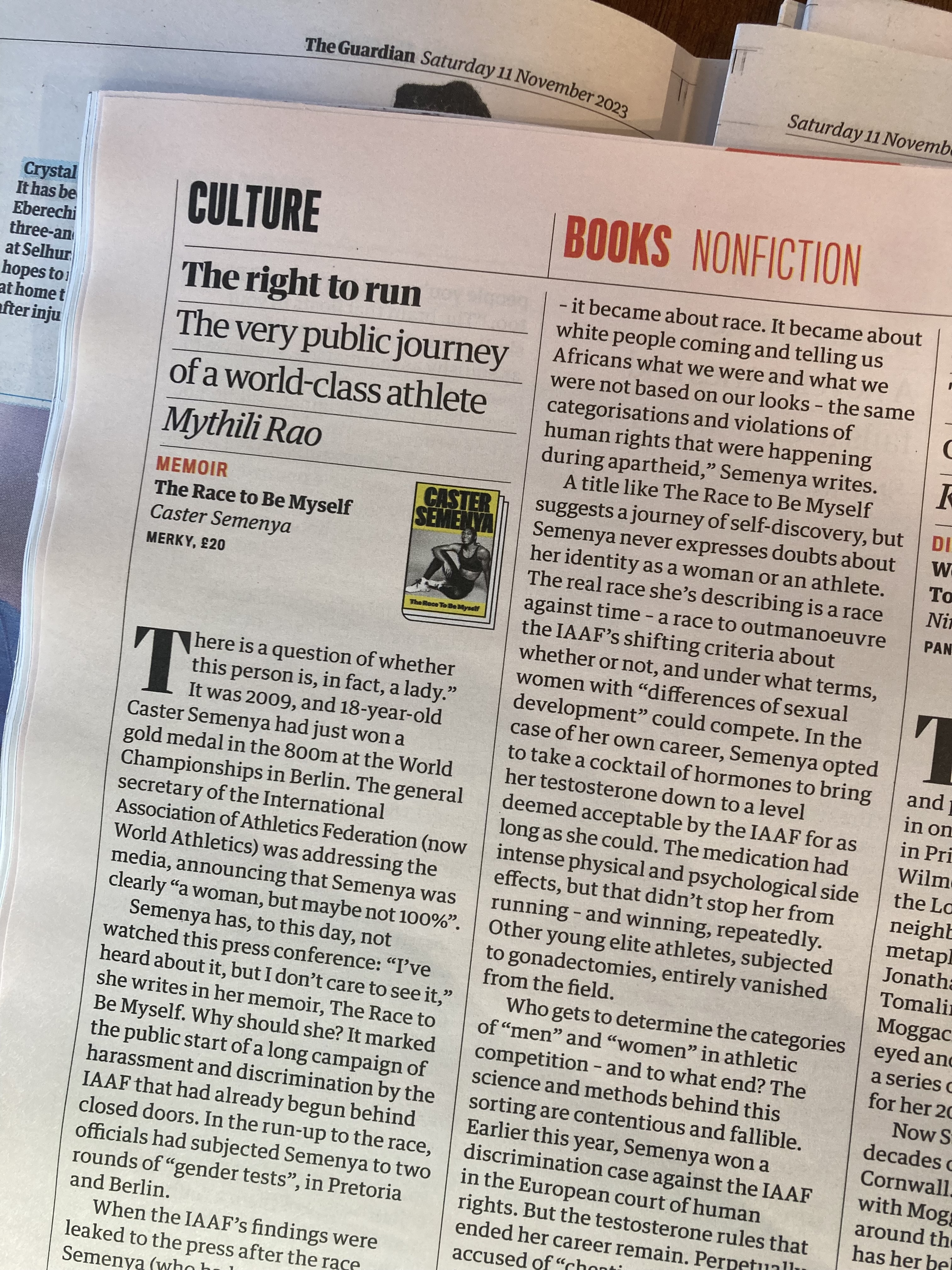
Running memoirs: Reviews of new books from Lauren Fleshman, Kara Goucher, and Caster Semenya

Earlier this year I got to review two new memoirs by Lauren Fleshman and Kara Goucher for the Washington Post. I’ve admired and followed the careers of both for a long time, so it was eye-opening and instructive to find out what they’d really experienced.

Last month, I also had the pleasure of reviewing Caster Semenya’s powerful new memoir for the Guardian as well.

In India, the complicated truth behind the killing of two teenagers

I wrote about The Good Girls: An Ordinary Killing by Sonia Faleiro for this weekend’s Washington Post. Here’s a snippet of my review:

As Faleiro probes the case, an extensive supporting cast emerges: meddlesome uncles, drunken police officers, hopelessly unqualified coroners, sensationalizing TV newsmen, a sneering intelligence officer and grandstanding politicians, all with a part — however undignified — to play in this story. … Everyone agrees that the girls’ deaths are a tragedy; no one knows quite whom to blame.

The Crazy Human Heart

I interviewed Daniel Mendelsohn for Virginia Magazine.  It was a treat to sit down with a critic whose work I’ve admired for a long time and talk about how he approaches his work. The headline comes from his take on Love Actually.  I’ve always loathed that movie, but on his urging, I’m going to try to let my guard down next Christmas when it’s on TV.


Screen Shot 2016-06-14 at 8.16.29 PMDo you believe in “guilty pleasures” of cultural consumption?

I really do believe that the high-low distinction is more invidious than not. The aesthetic components of “guilt”-inducing pleasures are usually melodrama and sentimentality. I have a great aversion to the aversion to sentimentality. To me, what made Mad Men unbearable was its own incredible overweening need to be cool. And because it was so cool and so cynical about everything, I just didn’t care about it, whereas in the first five minutes of watching Friday Night Lights, I thought I was going to die if I didn’t know those people were going to be okay.

Why not love something like Love Actually? What’s so terrible about just caving into your crazy human heart every now and then? You don’t always have to be armored.


Our Diaries, Ourselves

foldedclockI reviewed The Folded Clock: A Diary by Heidi Julavits and Ongoingness: The End of a Diary Sarah Manguso– and reflected on my own diary-keeping habits– over at The Los Angeles Review of Books.  The essay starts like this:

TODAY I DUG OUT an old diary from one of the large cardboard boxes that my husband and I never unpacked after our last move. It’s a spiral notebook with a multicolored cover. Thin lines of text, written in a black Pilot Precise pen, fill its pages, and my handwriting is narrow and mostly neat. The diary begins in the spring of 2005, a few months before I moved to New York. Flipping through it, I hoped to find some observation from my first hours, days, or weeks in New York — some early impression of the city that might foreshadow how the place would shape me.