The Critic’s Global Voice

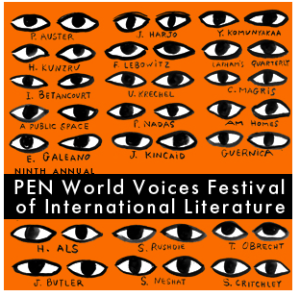
Screen Shot 2013-05-03 at 8.32.12 PMWith more than 100 world-class writers in dozens events spanning a week, this year’s PEN World Voices Festival line-up is pretty daunting.  I did manage to carve out time to make it out for a few things– and I blogged about an event earlier this week for Words Without Borders.  The topic was “The Critic’s Global Voice,” and the panel featured Jean-Euphèle Milcé, Ursula Krechel, and Mikhail Shishkin (with Bookforum editor Albert Mobilio moderating):
Reports of the death of American literary culture have been, well, at least a little exaggerated.  There’s no other way to explain the steady stream of lively essays bemoaning the health of book reviews, book critics, and literature itself. “Like hazing, reviewing is inflicted by the old and popular on the young and weak,” Elizabeth Gumport wrote, dismissing the genre in n+1. Literary culture is in the midst of a “long slide, reflecting not just a hard market but the manners of a bygone world,” as Michael Wolff recently put it in a churlish column predicting the demise of the New York Times Book Review.  At any rate, “most contemporary literary fiction is terrible,” J. Robert Lennon griped in Salon.

But what of the rest of the world?  Are we to believe that such assessments hold true for the public dialogue about books—and the role of “professional” readers—in other languages, other markets, other cultures?  Bookforum editor Albert Mobilio put the question of the role of criticism to writers from Russia (Mikhail Shishkin), Haiti (Jean-Euphèle Milcé), and Germany (Ursula Krechel) in a Wednesday night PEN festival discussion of “The Critic’s Global Voice.”

Head over to Words Without Borders for the rest of my dispatch, and for coverage of other PEN events (there’s a nice dispatch on the “Speaking in Languages on the Edge,” event, and interview with Susan Bernofsky, host of “How to Be a Translator” — and more coverage to come).

Hot Reads: Snapper, The Humanity Project, Red Spectres, My Animals and Other Family, The Other Side of the Tiber

Screen Shot 2013-04-22 at 9.39.00 PMFrom a lovestruck bird-chasing ecologist to the forgotten Gothic literature of 20th cent Russia: This week’s reviews are up.  Read more at Newsweek / The Daily Beast.

How to Create the Perfect Wife

Screen Shot 2013-04-22 at 11.36.59 PM

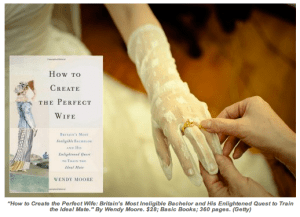
Thomas Day was wealthy and educated and ran in influential circles. But there was one problem. The 18th-century British philosopher’s lack of interest in polite manners and fashion—and, more important, personal hygiene—made it difficult for him to attract a suitable mate.

Day liked to quote a line from a poem titled “Advice to the Ladies”: “Wit like wine intoxicates the brain/Too strong for feeble women to sustain.”

You can find my full review of Wendy Moore’s utterly creepy and completely factual biography of Day, How to Create the Perfect Wife over at The Daily Beast / Newsweek.    

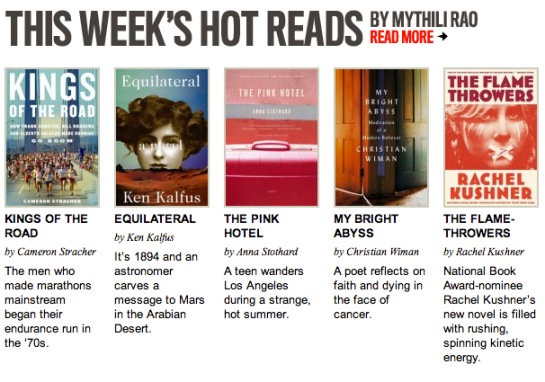
Hot Reads: Kings of the Road, Equilateral, The Pink Hotel, My Bright Abyss

This week’s Hot Reads feature a pink hotel, a red planet, a bright abyss, and a giant burning triangle.   Also, men in very short shorts.  Splendid books all around.  Visit The Daily Beast for the full reviews.

Revenge

16032127

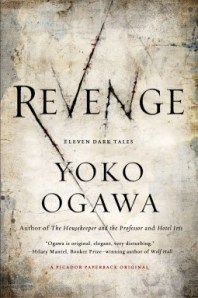
Head over to Words Without Borders for my review of Yoko Ogawa’s Revenge

If an enterprising reader were to map the through-lines linking the quiet, twisted (and subtly interconnected) tales of eccentric strangers and mysterious deaths in Yoko Ogawa’s new collection, Revenge, the resulting diagram would likely look something like a spider-web: Delicate, spindled, and perfectly designed for entrapment. The experience of reading Revenge is like getting caught in a beautiful, lethal web—or maybe, like wandering through a labyrinthine haunted mansion. These stories’ charm lies in their treacherous unpredictability. In each tale, it’s impossible to anticipate just what particular nightmarish turn the plot will take, or to guess what shadowy character or tiny detail from an entirely separate tale will reappear (a dead hamster left in a trashcan, a brace designed to make the wearer taller, a three-digit number used in a report). There is a spooky fun-house quality to this collection.

Hot Reads: The New Mind of the South, Honor, Between Man and Beast, A Tale for the Time Being, On the Ropes

Picture 1This week’s Hot Reads feature Japanese tsunami flotsam, “the ‘two-ness’ of Southerners,” an honor killing in 1970s London, and gorillas.

Math Anxiety and a Visit to MoMath

In fifth grade, four of my classmates and I tested out of elementary school math.  Instead of one more year of long division, every day during recess we marched ourselves across the muddy field separating the elementary and middle school and entered a strange land of lockers, period bells, puberty, and pre-algebra.

One day, while sitting in the back of Mrs. Lambiotte’s classroom (the back of the room, I discovered, was the best place for witnessing the novel hormonal mayhem of a seventh grade classroom — and also for finding the kinds of students who didn’t mind talking to a 10-year-old), I chewed a little too hard on my red pen.  A bitter taste erupted in my mouth; within moments, my jaw was covered in red ink. I fled to the bathroom.

This is a story that could’ve easily ended in tears and a lifelong loathing of math.  Instead, after some quality time with the faucet, I skulked back to Mrs. Lambiotte’s class, where after a mild ribbing, my spectacle was forgotten as my classmates got back to business of being twelve and thirteen-year-olds — trading moony glances, tightly folded notes, spitballs, and the like.

I lucked out that day.  But when I think about how scary school — and math in particular — has a potential to be, I think about the flash of terror that descended when I realized that I’d eaten open my pen, underscoring my presence as the classroom freak for once and for all in a burst of bright red ink across my face.

Everything that’s awkward about school is multiplied in the math classroom.  That’s why I was particularly excited to explore the topic of “math anxiety” last week — through an interview with Dr. Rose Vukovic, professor of teaching and learning at NYU’s Steinhardt School of Culture, Education, and Human Development and in a visit to MoMath, the National Museum of Mathematics in Manhattan.  Listen to the piece that resulted here.

Hot Reads: Middle Men, A Week in Winter, An Armenian Sketchbook, The Teleportation Accident, The Searchers

Picture 1Featuring a John Wayne western, teleportation experiments, indigestion in Armenia, and the highways of Los Angeles.  The full reviews here.

Hot Reads: The Love Song of Jonny Valentine, The Last Girlfriend of Earth, See Now Then, City of Devi

Picture 1

This week’s Hot Reads are all about looking for love — on stage, through a collapsed marriage, under the threat of nuclear destruction and even in the Gowanus Canal.  The full reviews are here.

Crowd-Sourcing a People’s Poem for the Inauguration

When I was in Florida for the Miami Book Fair this past November, I got the chance to see The Takeaway’s Miami affiliate, WLRN, launch a cool crowd-sourced short story project on Twitter.  They recruited Junot Diaz to supply their story with an opening line, sent it out over Twitter, and then watched as listeners pieced together a narrative. It was a real, live, many-headed story — messy but compelling.

Inspired by WLRN’s success, last week, my WNYC colleagues and I decided to attempt a similar project– this time with poetry rather than prose.

The inauguration provided a theme.  The Takeaway invited poet Kwame Dawes to kick things off with a discussion of inaugural poetry last Wednesday.  In that interview, Dawes presented the first (original) line for what would become our crowd-sourced poem:  Say nation. In the wake of quarrels, say hope. We Tweeted out the line and asked listeners to follow up with subsequent lines of their own using the hashtag #prezpoem.

Almost immediately, the lines started pouring in.  By the end of the week, we’d recieved hundreds of Tweets.  On Friday, Dawes returned to the program to survey the lines– and to share the poem he’d assembled from them.  (He was joined by poet Elizabeth Alexander, who delivered the 2009 inaugural poem —  and who had some very smart things to say about poetry and politics.  Hear their whole interview here.)

But it didn’t stop there.  For me, the best part of the project was the grand finale, which aired this morning.  After picking out a couple dozen of the strongest Tweets, I asked their authors to send audio of themselves reading their line (plus a few stanzas before and after). Piecing together the lines with the help of The Takeaway’s resident audio wizard Jay Cowit, a gorgeous audio poetry mash-up emerged.

This is what audio of the final poem sounded like.  And this is what the final text of the poem looked like:

A People’s Poem for the Inauguration

Say “nation.” In the wake of quarrels, say “hope.”
Be not divisive nor divided.

Say “neighbor.” Say, “What can I do?”
Doors open. Together walk through.
In the hurly-burly of the day’s governing
remember the freedom of peace.

At the dawn of uncertain tomorrows, say “change.”
While darkness floods our spirit, say “light” and shatter
all our scattering shadows.

Dream, “neighbor.” In the face of fear, sing, “mercy.”
Hear unity from voices that speak.

Say that freedom, both the blessing and right,
remain the provenance of open minds.
Acknowledge the dreams that birthed a great nation — say “freedom.”
Speak it into action and watch our dreams reshape the future.

And heart in hand, for the sake of the young,
of the old,
of all those who
wade thru injustice’s tide, say “freedom.”

Say and shout and sing! Progress is a storm and our voices the thunder.

Say “peace” for the hearts of a nation’s people, in times of grief.
Say one, say all. To abandon hope is to further the fall
Say “take my hand” to the downtrodden, the lost.
Sing harmonies that blend in a spectrum of love.

In the dark of failures, say “try”; encourage, persist to light.
Say friend, my hand for your strength, your eyes for my light as we forward together.
Say hope is ours.
Wash away morose pessimism and the failings of the nascent.
Remember our virtue; remember our lofty intent.
In the wake of the struggle, speak, so that together we all may speak courage.

Say “hope,” eyes turned not to the gauzy sky
nor to the brassy gates of power
but to the frost-bitten grass beneath our feet.

I need to hear, again, those antiquated words
in this new light.