Reviews, reviews, reviews! This week’s round-up includes some real masters of fiction — Junot Diaz, Shani Boianjiu and the Basque writer Bernard Atxaga — and some inquisitive, big-hearted non-fiction craftsmen too. The reviews are up on the Newsweek/Daily Beast site.
Hot Reads: Winter Journal, Summer Lies, Falling in Love with Joseph Smith, One Last Thing Before I Go, Penelope
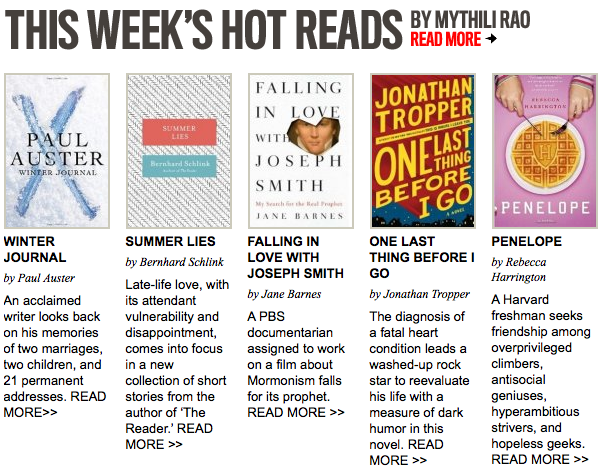 Get them while they’re hot! I reviewed new books from Paul Auster, Bernhard Schlink, and Jonathan Tropper this week, as well as a wonderful debut novel from Rebecca Harrington and an unconventional memoir about Mormonism by Jane Barnes for Newsweek/The Daily Beast.
The Planets

My review of The Planets by Sergio Chejfec is up with the latest issue of Words Without Borders:
“A sense of loyalty to his memory leads me to write,” the narrator of Sergio Chejfec’s novel The Planets confesses, thinking back on the life of his dearest friend. Of the duo, M was the story-teller, the writer-to-be, the absent-minded-professor (“always distracted to the point of appearing indifferent”) with a parable in every pocket, viewing the world askance. M was larger-than-life—until he was gone.
Hot Reads, All Fiction Edition: Dare Me, The Thing About Thugs, A Pimp’s Notes, In the Shadow of the Banyan, You & Me
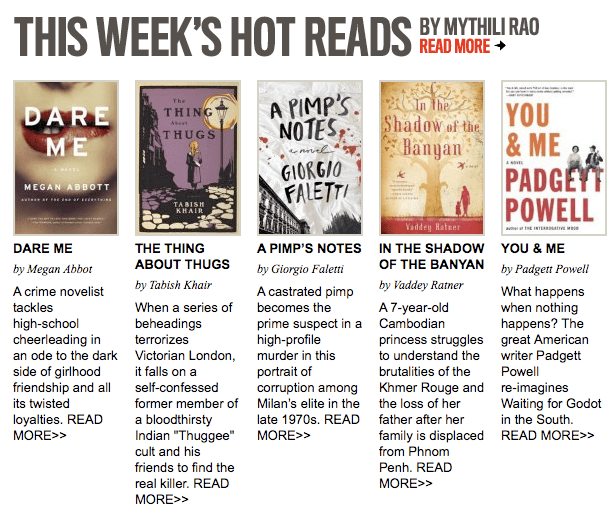
This week’s edition of Hot Reads for The Daily Beast/Newsweek included some real gems, like In the Shadow of the Banyan by Vaddey Ratner, The Thing About Thugs by Tabish Khair, Dare Me by Megan Abbott and A Pimp’s Notes by Giorgio Faletti. There’s a sweet new landing page for Hot Reads too.
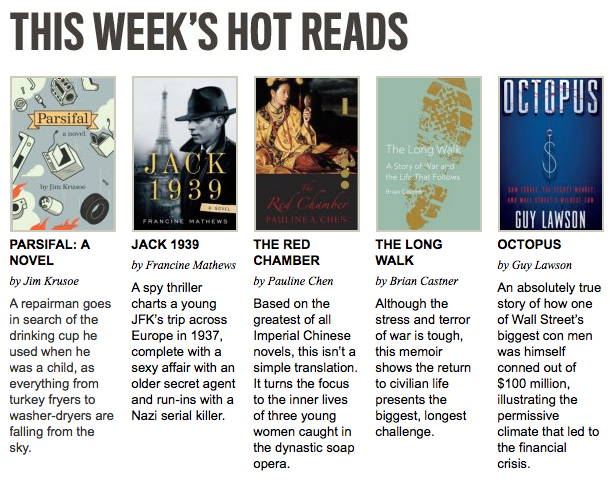
Hot Reads: Parsifal, Jack 1939, The Red Chamber, The Long Walk, Octopus
 I reviewed five hot new releases out July 2nd for The Daily Beast/Newsweek: Parsifal by Jim Krusoe, Jack 1939 by Francine Mathews, The Red Chamber by Pauline Chen, The Long Walk by Brian Castner and Octopus by Guy Lawson.
Recently on The Takeaway
A round-up of some of the segments I’ve particularly enjoyed working on for The Takeaway recently:
Listeners Respond: Things You Would Have Said A funny thing happens when you call up strangers and tell them you’re a public radio producer: They tell you things, personal things. After doing a short interview with Jackie Hooper, the author of The Things You Would Have Said, we were flooded with listener comments about things they wished they’d said to people in their past. I had the task of calling up a handful of listeners for longer phone interviews. We finally aired the stories of three listeners.
An Argument Against Happiness Last month the United Nations took up the topic of moving beyond conventional economic measures in a session called “Wellbeing and Happiness: Defining a New Economic Paradigm.” As a follow-up to our segment on this move, we invited Wake Forest University English Professor Eric Wilson, author of Against Happiness, onto the program. He argued the virtues of melancholy. “In America there is a sense that we can have all up with no down and all light with no dark — that we can be happy all the time,” he said. “I’m in favor of honestly facing the world as it is and trying to make the best of it.”
March Heat Breaks Records Across the Country According to figures from the National Oceanic and Atmospheric Administration, more than 15,000 weather records were set in the United States this March. John Harold, a farmer in Olathe, Colorado described the dilemmas the unseasonably warm weather had presented on his farm. Andrew Revkin of The New York Times’ “Dot Earth” blog summed things up this way: “Expect more of the same as the climate warms.”
Walmart’s Mexican Bribery Scandal Charles Fishman, author of The Wal-Mart Effect joined the program from his home in Mexico City to provide some perspective on reports of widespread bribery in Walmart’s Mexican operations. When Fishman was working on his book years before, he’d been struck by how rigidly ethical the company’s practices were in the US. “What’s interesting is instead of Walmart changing the culture of Mexico, Mexico changed the culture of Walmart,” Fishman said.
Baby Boomers Squeeze Savings to Support Parents and Children According to a new survey from Ameriprise Financial, more than half of baby boomers help their parents pay for groceries, medical expenses, or utilities. What’s more, a stunning 93% provide their adult children with financial support too. “Boomers’ attitudes about spending and saving have changed dramatically,” Suzanna de Baca of Ameriprise Financial explained. Boomer Mark Niedt in Denver described his own predicament. “While I’d love to be socking away some money for my own retirement, I’m really forced to derail that and give some assistance when I can,” he said.
Men — You Talk Too Much Yale organizational behavior professor Tori Brescoll shared her fascinating research about just how much powerful men and women talk in the workplace. “Give men power and they’ll talk a lot — but that wasn’t really the case for women,” Brescoll found. What’s more, women who were particularly outspoken paid a price: They were perceived as incompetent and unlikeable. “Indeed what I found is that whether it was politics or business, really talkative women were really slammed,” she said.
A Sign of the Times: Underearners Anonymous Genevieve Smith‘s cover story in the latest issue of Harper’s magazine describes her experiences in “Underearner’s Anonymous,” a 12-step program for the chronically underpaid. She explained how following the country’s economic recovery had made her a “connoisseur of financial pessimism” and why she was drawn to the program.
Behind the Scenes Diplomacy for Chen Guangcheng NYU Law Professor Jerome Cohen has maintained a friendship with Chinese dissedent Chen Guangcheng for more than a decade and remained in touch with him as he tried to navigate between US and Chinese officials in the days following his daring escape from house arrest. “He was confronted by two unattractive opportunities,” Cohen explained.
I Am an Executioner: Love Stories
Dangerous, misunderstood creatures—a man-eating tiger, a wild elephant, and of course, the title executioner, to name just a few—populate Rajesh Parameswaran’s debut collection of short stories. I Am An Executioner offers a fiercely creative—and deeply morbid—vision of what it takes to stay alive. The struggle for survival dominates the lives of these characters; it’s finally their most feral instincts that carve their fates.
I reviewed I Am an Executioner: Love Stories for Newsweek/The Daily Beast. The full review is here.
A Partial History of Lost Causes
For Newsweek/The Daily Beast, I reviewed A Partial History of Lost Causes by Jennifer DuBois:

Jennifer DuBois’s debut novel opens with an epigraph from Vladimir Nabakov: “We are all doomed, but some of us are more doomed than others.” Perhaps an equally appropriate selection for this tender but sharp-edged book would have been the refrain of Elizabeth Bishop’s poem “One Art”: “The art of losing isn’t hard to master.” This is a story about learning to face loss and failure—if not with grace or composure, then at least with personal integrity.
The full review is here. (Also, here’s what Gary Shteyngart had to say about this book: “Hilarious and heartbreaking and a triumph of the imagination. Jennifer duBois is too young to be this talented. I wish I were her.”)
Schoolgirl
 I reviewed Osamu Dazai’s Schoolgirl for Words Without Borders.
Written in 1939 but only now translated into English for the first time, Osamu Dazai’s Schoolgirl—a slim, precocious novella narrated by a schoolgirl of indeterminate age—was stylish and provocative in its time. Almost three-quarters of a century later, its prescience seems eerie; hardly anything about this book seems to have aged, least of all the narrator herself, who is perfectly preserved somewhere along the road to adolescence. Though she’s still young enough to entertain herself with nonsensical songs and inventive daydreams as she walks home from school (“I thought today I will try to pretend that I am from somewhere else, someone who has never been to this country town before”), she’s old enough to know her childhood is fast coming to a close. “It made me miserable that I was rapidly becoming an adult and that I was unable to do anything about it,” she reflects.
The full review is here. It’s also definitely worth spending some time with the rest of this month’s Words Without Borders issue (which happens to be all about sex).
We Are Equal
The more things change, the more the stay the same. At least that’s the feeling I’ve been getting reading through some of John Kennedy Toole’s fifty-plus-year-old writings in Butterfly in the Typewriter, a new biography of the writer that recently landed on my desk.
Entertainingly, many of Toole’s observations on New York still seem fresh all these years later. For example, Toole describes — with a certain grim glee — “the masochism of living in New York, which has become the Inferno of America” (that is to say, it typifies “the American Dream as Apocalypse”). But I was especially struck by this response to an exam question Toole wrote in 1955:
Our government tells us we are equal, even though we enjoy economic freedom. There are, of course, many citizens who believe wholeheartedly that this is true. It is taught to all school children as the catechism of our government, as dogma.
But when these children are faced with the stark reality that school is over, that they are no longer “actives” in their fraternity, that they have their degree in Business Administration and that the regular checks from home are no longer forthcoming, the dogma which they so firmly believed explodes in their faces.
I was immediately reminded of a recent college graduate who joined The Takeaway a few months ago. “We also were told a narrative our whole lives that if we did well in school and attended college, you know, there’d be good middle class jobs waiting for us,” Chris Galloway said. As he explained on the show, when Chris finished his degree and found himself jobless — and tens of thousands of dollars in debt — his perspective changed dramatically.
One could argue that the factors Toole observed exploding “the catechism of our government” half a century ago were in many ways different from the factors Galloway and other young graduates experience today. But the tension between that “dogma” and the reality — the tension between a promising young graduate’s expectations, aspirations, and prospects — seems pretty much the same.
(For more on Toole, check out Cory McLachlan’s wonderful essay in The Millions about the process of researching Butterfly in the Typewriter).
 Mythili G. Rao