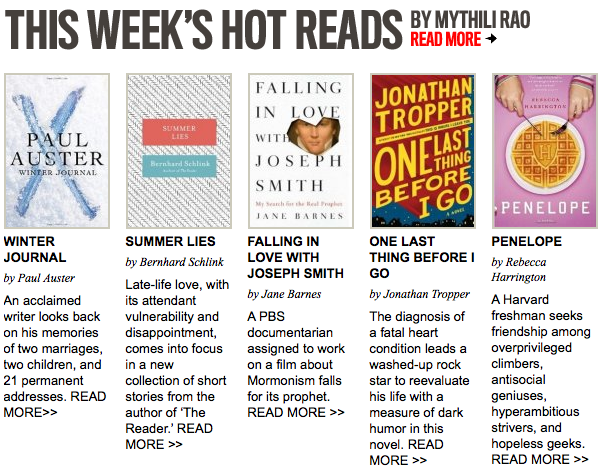
 Get them while they’re hot! I reviewed new books from Paul Auster, Bernhard Schlink, and Jonathan Tropper this week, as well as a wonderful debut novel from Rebecca Harrington and an unconventional memoir about Mormonism by Jane Barnes for Newsweek/The Daily Beast.
Tag Archives: books
The Planets

My review of The Planets by Sergio Chejfec is up with the latest issue of Words Without Borders:
“A sense of loyalty to his memory leads me to write,” the narrator of Sergio Chejfec’s novel The Planets confesses, thinking back on the life of his dearest friend. Of the duo, M was the story-teller, the writer-to-be, the absent-minded-professor (“always distracted to the point of appearing indifferent”) with a parable in every pocket, viewing the world askance. M was larger-than-life—until he was gone.
Hot Reads, All Fiction Edition: Dare Me, The Thing About Thugs, A Pimp’s Notes, In the Shadow of the Banyan, You & Me
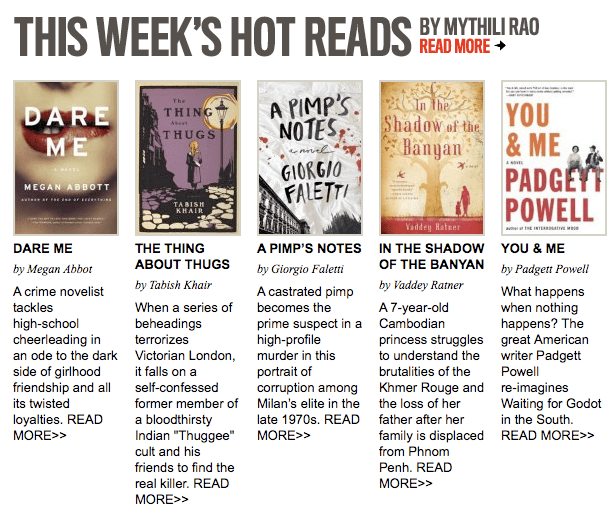
This week’s edition of Hot Reads for The Daily Beast/Newsweek included some real gems, like In the Shadow of the Banyan by Vaddey Ratner, The Thing About Thugs by Tabish Khair, Dare Me by Megan Abbott and A Pimp’s Notes by Giorgio Faletti. There’s a sweet new landing page for Hot Reads too.
Hot Reads: Parsifal, Jack 1939, The Red Chamber, The Long Walk, Octopus
 I reviewed five hot new releases out July 2nd for The Daily Beast/Newsweek: Parsifal by Jim Krusoe, Jack 1939 by Francine Mathews, The Red Chamber by Pauline Chen, The Long Walk by Brian Castner and Octopus by Guy Lawson.
I Am an Executioner: Love Stories
Dangerous, misunderstood creatures—a man-eating tiger, a wild elephant, and of course, the title executioner, to name just a few—populate Rajesh Parameswaran’s debut collection of short stories. I Am An Executioner offers a fiercely creative—and deeply morbid—vision of what it takes to stay alive. The struggle for survival dominates the lives of these characters; it’s finally their most feral instincts that carve their fates.
I reviewed I Am an Executioner: Love Stories for Newsweek/The Daily Beast. The full review is here.
A Partial History of Lost Causes
For Newsweek/The Daily Beast, I reviewed A Partial History of Lost Causes by Jennifer DuBois:

Jennifer DuBois’s debut novel opens with an epigraph from Vladimir Nabakov: “We are all doomed, but some of us are more doomed than others.” Perhaps an equally appropriate selection for this tender but sharp-edged book would have been the refrain of Elizabeth Bishop’s poem “One Art”: “The art of losing isn’t hard to master.” This is a story about learning to face loss and failure—if not with grace or composure, then at least with personal integrity.
The full review is here. (Also, here’s what Gary Shteyngart had to say about this book: “Hilarious and heartbreaking and a triumph of the imagination. Jennifer duBois is too young to be this talented. I wish I were her.”)
Schoolgirl
 I reviewed Osamu Dazai’s Schoolgirl for Words Without Borders.
Written in 1939 but only now translated into English for the first time, Osamu Dazai’s Schoolgirl—a slim, precocious novella narrated by a schoolgirl of indeterminate age—was stylish and provocative in its time. Almost three-quarters of a century later, its prescience seems eerie; hardly anything about this book seems to have aged, least of all the narrator herself, who is perfectly preserved somewhere along the road to adolescence. Though she’s still young enough to entertain herself with nonsensical songs and inventive daydreams as she walks home from school (“I thought today I will try to pretend that I am from somewhere else, someone who has never been to this country town before”), she’s old enough to know her childhood is fast coming to a close. “It made me miserable that I was rapidly becoming an adult and that I was unable to do anything about it,” she reflects.
The full review is here. It’s also definitely worth spending some time with the rest of this month’s Words Without Borders issue (which happens to be all about sex).
We Are Equal
The more things change, the more the stay the same. At least that’s the feeling I’ve been getting reading through some of John Kennedy Toole’s fifty-plus-year-old writings in Butterfly in the Typewriter, a new biography of the writer that recently landed on my desk.
Entertainingly, many of Toole’s observations on New York still seem fresh all these years later. For example, Toole describes — with a certain grim glee — “the masochism of living in New York, which has become the Inferno of America” (that is to say, it typifies “the American Dream as Apocalypse”). But I was especially struck by this response to an exam question Toole wrote in 1955:
Our government tells us we are equal, even though we enjoy economic freedom. There are, of course, many citizens who believe wholeheartedly that this is true. It is taught to all school children as the catechism of our government, as dogma.
But when these children are faced with the stark reality that school is over, that they are no longer “actives” in their fraternity, that they have their degree in Business Administration and that the regular checks from home are no longer forthcoming, the dogma which they so firmly believed explodes in their faces.
I was immediately reminded of a recent college graduate who joined The Takeaway a few months ago. “We also were told a narrative our whole lives that if we did well in school and attended college, you know, there’d be good middle class jobs waiting for us,” Chris Galloway said. As he explained on the show, when Chris finished his degree and found himself jobless — and tens of thousands of dollars in debt — his perspective changed dramatically.
One could argue that the factors Toole observed exploding “the catechism of our government” half a century ago were in many ways different from the factors Galloway and other young graduates experience today. But the tension between that “dogma” and the reality — the tension between a promising young graduate’s expectations, aspirations, and prospects — seems pretty much the same.
(For more on Toole, check out Cory McLachlan’s wonderful essay in The Millions about the process of researching Butterfly in the Typewriter).
Inscrutable India
 As promised, more reflections on this year’s eventful Jaipur Literature Festival:
Up until the day before JLF began, there were rumors that Rushdie — who reportedly had been dropped from the official program due to “a very real threat of violence at the venue” — planned to make a surprise appearance. Then, on the first day of the festival, Rushdie issued a statement: “I have now been informed by intelligence sources in Maharashtra and Rajasthan that paid assassins from the Mumbai underworld may be on their way to Jaipur to ‘eliminate’ me,” he wrote. “While I have some doubts about the accuracy of this intelligence, it would be irresponsible of me to come to the Festival in such circumstances.”
To voice their disapproval of the circumstances of Rushdie’s absence, four writers, Hari Kunzru, Amitava Kumar, Jeet Thayil, and Ruchir Joshi, read from The Satanic Verses — a book that has been banned in India — in their sessions later that day. They were subsequently advised to leave the festival, and the local police opened an investigation into their activities. There were still four days of panels left.
What was left to discuss? Anything but Rushdie. On guidance from the event organizers, everyone from Shashi Tharoor to David Remnick was talking around the debacle, momentarily alluding to it — knowingly, coyly — but never quite addressing it or the full array of issues it raised on India’s thorny history with censorship, religious fundamentalism, democratic and bureaucratic processes (and Salman Rushdie himself). It was a strange predicament for a symposium of ideas to find itself in. “So many awkward Rushdie references,” I scribbled in my notebook after day three. That’s all they were, though — fleeting references, fleetingly observed.
The show must go on! the organizers seemed to be saying. And, with 200-some authors still lined up to speak, it did. Lively on-stage conversations abounded. High-profile ones did too. Amy Chua debated economic policy. Teju Cole riffed on why it wasn’t necessarily only African writers who inspired him to become a writer. Oprah advocated for women’s rights. Fatima Bhutto discussed the future of Pakistan. Akash Kapur meditated on India’s changing rural landscape. Yet the topic of Rushdie continued to remain largely untouched, and a nagging question lingered in my mind: What kind of real intellectual discussion could go on in a setting that had proved itself so hospitable to self-censorship? When you gathered a hundred-thousand writers and book-lovers and then stripped away the opportunity for a truly free public exchange of ideas, what was left?
Head over to The Millions to read my full essay, “Inscrutable India: Jaipur Literature Festival’s Baffling Bazaar of Culture and Commotion.”
photo by me: creepy art on display at Diggi Palace during JLF
Mr. g
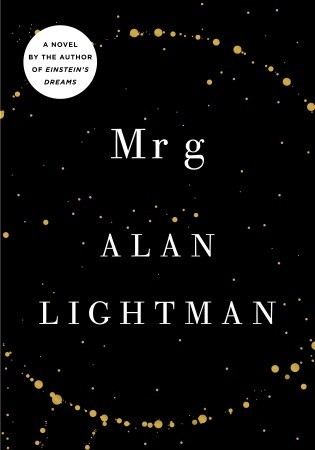 I reviewed Mr. g by Alan Lightman for Newsweek/The Daily Beast:
For a book with no hidden plot twists—the reader knows that Mr. g’s experiments in cosmos-building in his pet universe, Aalam-104729, are bound to lead to the birth of mankind—Mr. g is strangely suspenseful. It turns out that the act of creation is profoundly transformative, even for a formless, timeless, all-powerful primogenitor. The plot moves forward as the universe gradually unfolds, but the real story here is about Mr. g’s inner awakening.
 Mythili G. Rao